Hébergez votre agent IA sur un VPS
performant, disponible 24/7.

Deploy Hermes, OpenClaw or the tool of your choice on reliable, secure infrastructure — no GPU or inference server needed.
11,45 €
excl VAT/month

Héberger en France
Disponible 24/7
Root complet en 5 minutes
Virtual Private Cloud Control Panel

What is a self-hosted AI agent?

Un agent IA auto-hébergé tourne sur votre propre serveur et fait le travail à votre place : surveiller une boîte mail, appeler des API, générer des rapports, déclencher des scripts.

Chatbot
You
AI (Cloud)
Reply

It only works while you're interacting with it. Close the window and nothing runs in the background anymore.
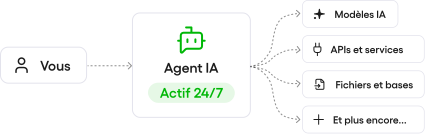
Agent on a VPS Self-hosted

active (running)

It runs on your server and keeps working even when you're not connected.

A laptop isn't enough: put it to sleep or change networks, and the agent stops. A VPS stays on, connected, and reachable 24/7.

Gardez toujours un œil sur ce qui compte

Because the server runs around the clock, your agent tracks your activity 24/7 and flags what matters, without you having to restart it.

Continuous activity tracking

Your agent sends a regular update on your key metrics, even at night or on weekends.

Automated monitoring

It tracks competitors, SEO, or brand mentions, and prepares a report without you lifting a finger.

Always up-to-date data

It collects and formats your data in the background, ready whenever you need it.
Laissez votre agent s'occuper des tâches qui se répètent

Hand it the repetitive work: your agent runs in the background and takes care of it, without constant supervision.

Automatisez vos opérations techniques

Suivez vos déploiements, analysez vos logs et relancez automatiquement vos jobs lorsque nécessaire.

Accélérez le traitement des demandes

Triez vos e-mails, analysez les demandes entrantes, préparez des réponses et faites remonter automatiquement les demandes prioritaires.

Gardez votre infrastructure opérationnelle

Automatisez vos sauvegardes, contrôles d'uptime, alertes et traitements liés aux incidents.

Connectez votre agent à vos outils

Connectez votre agent aux applications, API et services nécessaires à vos automatisations.

Communiquez

Telegram, Discord, Whatsapp, Gmail, Claude, ChatGPT, Slack…

Connectez

API, webhooks et services externes.

Automatisez

Faites circuler les informations et déclenchez vos workflows.

Créer mon VPS Agent IA 

Livré en moins de 5 minutes · Sans engagement, majoration ou renouvellement

Why choose a VPS for your AI agent?

Un agent a besoin de ressources dédiées, d'un accès root et d'une machine allumée en permanence.

Full root access

An agent needs to install its dependencies, open ports and run system commands. You get unrestricted root SSH access on your machine.

KVM isolation

Un agent qui exécute du code mérite un environnement séparé de votre machine personnelle. La virtualisation KVM isole entièrement votre VPS des autres clients.

24/7 availability

Your scheduled tasks and recurring automations run continuously, on redundant infrastructure with 24/7 technical support included.

Data hosted in France

Your servers are hosted in our datacenters in France, which simplifies your GDPR compliance and reduces latency to your European users.

Compatible with open source AI agents

You choose the runtime, you install it and you configure it yourself on your VPS. The most widely used open source projects run on a standard Linux distribution with root access.

An orchestrator relies on a PostgreSQL database and on a scheduler that must run permanently: it needs a server that stays powered on, plus some memory for the database and the agents it triggers.

Python agent frameworks work the same way on a standard Linux distribution: LangChain, AutoGen, CrewAI, AutoGPT, or n8n for no-code automations.

Déployer mon agent IA sur VPS 

Livré en moins de 5 minutes · Sans engagement, majoration ou renouvellement

OpenClaw
Autonomous agent
Runs tasks and scripts directly on your server.
Open Interpreter
Autonomous agent
Understands your instructions in natural language and executes code.
Hermes Agent
Autonomous agent
A persistent agent, with memory and scheduled tasks.
Paperclip
Orchestrator
Coordinates a whole team of agents: roles, budgets, recurring tasks.

Les projets mentionnés sont indépendants de FirstHeberg. Nous fournissons l'infrastructure VPS ; vous gardez la maîtrise de leur installation et de leur configuration.
FAQ - VPS for AI Agent

No, and that's normal — that's not what the VPS does. It hosts the agent, the program that receives your instructions, calls a model, and does the work. The computation itself stays with the model provider (Anthropic, OpenAI, Mistral…), and you're billed per use with your own API keys. So no GPU is needed, just memory, a solid network, and a server that stays on. Running an LLM locally needs a machine with a GPU, and our VPS range doesn't offer that. If you still want a local model for small tasks (embeddings, lightweight classification), some compact models run on CPU with a few GB of RAM, but performance stays well below a commercial-grade LLM. For a production agent, the API remains the simplest choice: you switch provider or model with one line of configuration, without ever reinstalling a GPU driver or managing quantization.

No, it arrives bare (well, with the OS of your choice and full root access). Installing the AI agent runtime you want is on you. The server is ready in under 5 minutes, and you keep control of your versions and your data. Specifically, once your VPS is delivered, you connect over SSH, clone the repository for your chosen runtime (OpenClaw, Hermes Agent, a Python framework…), install its dependencies, then run it as a systemd service so it survives reboots. Expect roughly fifteen minutes to an hour for a first deployment, depending on the runtime. Our documentation covers installing the most requested runtimes, and technical support helps if you get stuck on the server side (network, firewall, resources) — installing and configuring the agent itself stays on your end.

Mostly on the runtime. As a rough guide, each project's official docs give ballpark figures: 1 GB RAM for Hermes Agent, 2 GB for OpenClaw or n8n (4 to 8 GB if OpenClaw drives a browser), 4 GB for Claude Code. CPU matters less than RAM here, since model computation goes to the provider over API. The simplest approach is to test with your real workload, then adjust vCore, RAM and storage from your customer area. Storage matters mainly if your agent keeps a long history or a local vector index: a few GB covers everyday use, more if you store embeddings or detailed logs. To get started, a 2 vCore / 4 GB RAM configuration covers most of the runtimes mentioned; you watch actual usage from your customer area and scale up as soon as RAM or CPU nears its limit, without migrating to another server.

Yes. Full root access, so you set up whichever provider you want (Anthropic, OpenAI, Mistral, open source, doesn't matter) with your own API keys. Nothing is blocked on external services, subject to our terms of use. You can even run several keys and providers side by side on the same agent: a fast, cheap model for sorting requests, a more capable one for complex tasks, each billed separately by usage. Keys are stored as ordinary environment variables (a .env file, a secrets manager): FirstHeberg has no access to them and never shares them. If a provider changes its pricing or rate limits, you switch to another one by simply editing your agent's configuration, without reinstalling anything on the server.

It depends on usage. You trade a flat fee for two variable costs, the VPS and model calls billed on actual use. What brings the bill down is that several agents can run on the same server and you can switch models depending on the task. For light, occasional use, a subscription stays simpler; for an agent running continuously, or several projects at once, self-hosting quickly pays off. A rough figure: a typical AI subscription runs around €20 to €30 a month for individual use, regardless of actual traffic. With a VPS at a few euros a month plus API calls billed per token, an agent handling a moderate volume often costs less once it runs several hours a day. The advantage disappears if the agent sits idle most of the time: in that case, a usage-based subscription stays easier to budget.

Yes, that's actually the whole point. Each agent is a process: you run them side by side, as separate systemd services or Docker containers, on the same machine. The only limit is available memory: not a license, not a seat count. Count each agent's RAM plus its dependencies (database, vector index), and bump resources from your customer area if needed. In practice, most users run between 2 and 5 agents on a mid-sized VPS (4 to 8 GB RAM) without any slowdown, as long as the agents don't all share the same local model or the same large database. A good habit is giving each agent its own system user and its own configuration folder: it avoids dependency conflicts and makes it easy to restart or stop a single agent without touching the others.

Yes, both ways. Nothing filters outbound calls to model APIs or your third-party services. To receive webhooks, the VPS has a public IPv4 — open the port you need and they arrive directly, no need for a temporary tunnel like you'd use from a home machine. The firewall stays under your control, like the rest of the system. For integrations that require an HTTPS URL (most modern webhook platforms do), you install a lightweight reverse proxy (Nginx or Caddy) with a free Let's Encrypt certificate in front of your agent: a few lines of configuration are enough, and certificate renewal happens automatically. You can also restrict webhooks to a list of allowed IPs or add a secret token to the URL to stop a third party from triggering your agent by mistake.

Run the agent as a systemd service with "systemctl enable" and it restarts on its own with the machine. On the infra side, we commit to a 4 business-hour repair time for hardware or network failures, with support reachable 24/7. Backups and snapshots stay available as an option from the customer area. To go further, a process manager like supervisor, or a simple Restart=on-failure rule in the systemd service file, restarts the agent automatically if it crashes, without waiting for a full server reboot. We monitor infrastructure availability (network, hypervisor, storage) 24/7 on our side; monitoring the agent's own application (logs, alerts on business errors) stays yours to set up — for example, with a script that notifies you on Telegram or by email after repeated failures, without waiting for you to notice it yourself.

No. The price shown is the monthly price, with no commitment and no increase on renewal: the same amount in month thirteen as in month one. You can increase vCore, RAM and storage whenever you want, and the price then simply follows the added resources. This is a policy applied across our whole VPS range, not a promotion limited to the AI agent offer: unlike some hosts that advertise an introductory price valid only for the first year, the price you see when ordering stays the price you pay afterward, month after month, with no surprise on the next invoice. If you change your configuration (more RAM to run an extra agent, for example), only the cost of the added resources is added to the bill; the base price never changes retroactively.

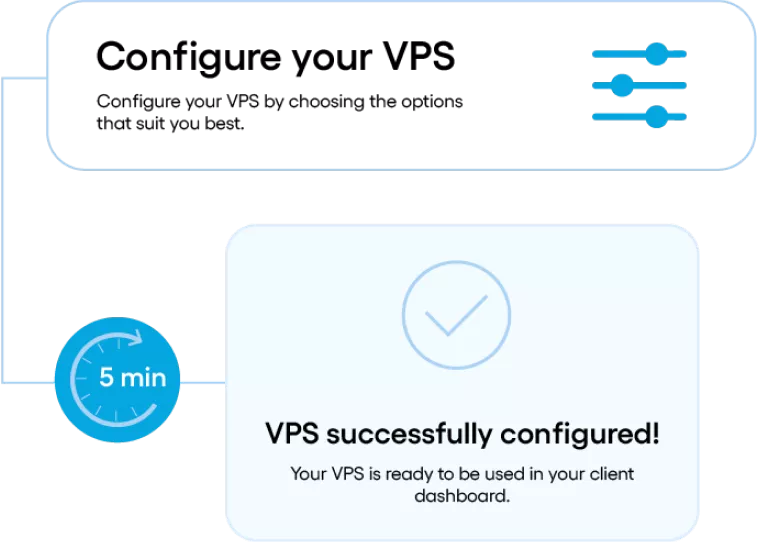
Configure my AI agent VPS 

5 minutes delivery

Checkout in 5 minutes!

Benefit from the validation of your VPS in less than 5 minutes* at Firstheberg! The validation of your order is automatic and your VPS is delivered within half an hour.

*Automatic delivery for customers residents of France, Belgium, Swiss and Luxembourg and subject to condition that the customer account shows no irregularity.

Features included with our VPS offer

Déploiement rapide Fast deployment
Deploy your VPS in less than 5 minutes with Windows or more than 10 Linux distributions.
Débits garantis Guaranteed speeds
Benefit from a guaranteed speed on the entire VPS offer ranging from 200 Mbps to 1 Gbps (10 Gbps optional) and a "burst" connection of 1 Gbps in WAN and LAN.
Reverse DNSReverse DNS
Change the reverse of your VPS directly from your customer area, thanks to our simplified tool for managing your DNS reverses.
GTR 4H GTR 4H
We commit to restoring your VPS within 4 working hours in the event of a hardware or network failure upon opening a support ticket on your client area.

Operating systems

A wide range of Windows & Linux OS available.
Choose and install the OS of your choice among the most popular on the market.

Firstheberg offers you the most popular operating systems for all of our VPS. You have the choice among several Linux distributions, such as Debian, CentOS Stream or Ubuntu, as well as Windows Server.

ubuntu Ubuntu
ubuntu2604 Ubuntu 26.04
ubuntu2504 Ubuntu 25.04
ubuntu2404 Ubuntu 24.04 LTS
ubuntu2204 Ubuntu 22.04 LTS
debian Debian
debian13 Debian 13
debian12 Debian 12.9
debian11 Debian 11.9
rockylinux Rockylinux
rockylinux9 RockyLinux 9.5
rockylinux10 RockyLinux 10
almalinux Almalinux
almalinux9 AlmaLinux 9.5
suse Suse
suse15 Suse 15
cloudlinux Cloudlinux
cloudlinux96 Cloud Linux 9.6
fedora Fedora
fedora42 Fedora Cloud 42
fedora41 Fedora Cloud 41
centos Centos
centosstream9 CentOS Stream 9
centosstream10 CentOS Stream 10
windows Windows
win2022std Windows Server 2022 Standard
win2019std Windows Server 2019 Standard
Applications
WordPress WordPress
NextCloud NextCloud

ISPConfig ISPConfig
VestaCP VestaCP
Firstheberg est la marque commerciale de la société Techcréa Solutions, société créée en 2010, au capital social de 235 049 €. Firstheberg est le spécialiste de l’hébergement web, VPS Linux et Windows et serveur dédié pas cher et pour tous. N’hésitez pas à consulter nos offres d’hébergement mutualisé et noms de domaine offerts, VPS SSD Linux OpenVz, VPS SSD Linux et VPS SSD Windows Qemu, et Serveurs dédiés HDD et SSD.